
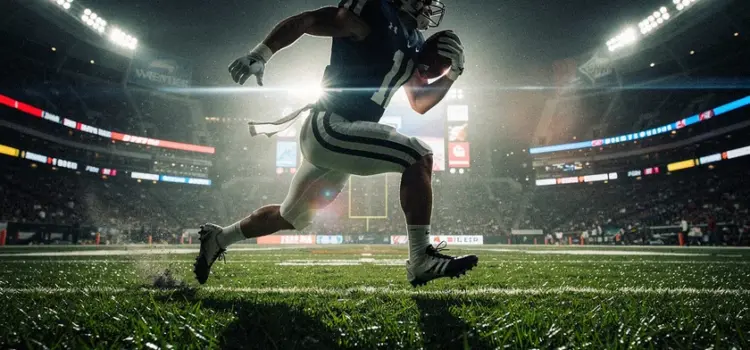
The Washington Commanders are being projected to select Notre Dame running back Jeremiyah Love with the seventh overall pick in the 2026 NFL Draft, according to ESPN’s Field Yates. Love rushed for more than 1,600 yards in his final college season and clocked a 4.36-second 40-yard dash at the combine, making him the most explosive skill-position prospect available at that range of the board.
Washington holds the No. 7 selection and owns no pick in the second round. That constraint shapes the calculus considerably. The Commanders cannot afford a swing-and-miss, and Love’s production floor is hard to argue against.
Washington Commanders’ Backfield Situation Entering the 2026 Draft
Washington’s running back room heading into the 2026 draft is unsettled enough that Yates characterized it as a “shaky situation” — the precise opening that makes a premium prospect worth a top-ten investment. General manager Adam Peters has shown a willingness to prioritize offensive infrastructure around second-year quarterback Jayden Daniels. Adding a dual-threat back of Love’s caliber would extend that commitment.
Running backs drafted in the top ten are rare in the modern NFL. The position is routinely devalued in draft-capital discussions. Washington’s specific roster construction, however, creates an exception to that conventional wisdom. Daniels thrives in play-action and zone-read concepts — schemes that demand a backfield partner who can threaten defenses both between the tackles and as a receiving option. Love’s 10.4 yards per catch average in 2025 signals he can do exactly that.
Breaking Down Jeremiyah Love’s College Profile
Jeremiyah Love posted over 1,600 rushing yards during his final season at Notre Dame, placing him among the most accomplished running backs in college football last year. His combine 40-yard dash of 4.36 seconds confirmed what the tape already suggested: Love accelerates through the second level with the kind of burst that translates directly to NFL yards after contact.
His receiving efficiency stands out as much as his rushing volume. Averaging 10.4 yards per catch in 2025 reflects a back who wins in space and creates after the catch rather than simply catching screens at the line of scrimmage. For offensive coordinator Kliff Kingsbury, who returned to the NFL as Washington‘s play-caller, a weapon with that dual-threat profile opens an entirely different menu of formations and personnel groupings.
One fair counterargument: investing a top-seven pick in a running back carries philosophical risk in a pass-first league where positional value erodes faster than at almost any other skill spot. The Washington Commanders would be betting that Love’s receiving versatility and Daniels’ rushing threat together create a schematic multiplier that justifies the draft-capital outlay.
What Love Would Add to Washington’s Offensive Scheme
Jeremiyah Love would give the Washington Commanders a genuine three-down back capable of aligning in the slot, absorbing target share out of 11 and 12 personnel, and serving as a check-down valve on third downs. That kind of backfield versatility changes how defensive coordinators deploy their coverage shells against Washington.
Washington’s offense under Kingsbury already leans on pre-snap motion and RPO concepts to generate easy completions. A back with Love’s 4.36 speed forces linebackers and safeties to declare their assignments earlier. That creates the leverage the scheme needs. Love is not just a straight-line speedster — he processes quickly at the mesh point and makes decisive cuts, which matters more in NFL zone schemes than raw athleticism alone. His snap count usage at Notre Dame included significant work in two-minute drills, suggesting he can handle a full-game workload rather than functioning as a situational piece.
Key Developments in Washington’s Draft Outlook
- Field Yates of ESPN specifically argued that No. 7 represents Love’s draft floor, framing the selection as a “home run move” given Washington‘s roster needs.
- Love participated in the 40-yard dash at the NFL Scouting Combine but did not take part in other on-field drills, making his 4.36-second time the primary measurable from Indianapolis.
- Yates described Love as “the most dynamic offensive player in this class,” positioning him above wide receivers and tight ends in overall impact projection.
- No team picking ahead of Washington is currently projected to select Love, meaning the Commanders would not need to trade up to land him.
Salary Cap and Draft Strategy for the Washington Commanders
Washington’s salary cap situation adds another layer to the draft strategy. Selecting Love at No. 7 would lock in a fifth-year option on a rookie deal through at least 2030, providing cost-controlled production at a position where the open market commands significant money. For a franchise still building cap flexibility around a quarterback on a rookie contract, that structure matters.
The Washington Commanders’ depth chart at running back carries real uncertainty into April. Addressing it with a first-round pick rather than a free-agent signing reflects a front-office philosophy that prioritizes long-term asset control over short-term fixes. Peters has consistently favored building through the draft since arriving in Washington. Pulling the trigger on Love at seven would align squarely with that organizational approach — and deliver one of the draft’s most complete offensive prospects at a position of genuine need.
Frequently Asked Questions
Why are the Washington Commanders picking at No. 7 in the 2026 NFL Draft?
Washington’s No. 7 overall selection reflects the team’s finish in the 2025 NFL regular season standings. The Commanders hold no compensatory second-round pick in 2026, making the first-round slot their earliest and most valuable draft asset.
How many rushing yards did Jeremiyah Love record in his final college season?
Love surpassed 1,600 rushing yards during his final season at Notre Dame, a total that ranked among the highest single-season outputs for running backs in the 2025 college football campaign.
What drills did Jeremiyah Love complete at the NFL Scouting Combine?
Love ran the 40-yard dash — clocking 4.36 seconds — but did not participate in other on-field workouts at the Indianapolis combine, leaving his timed speed as the primary athletic benchmark for evaluators.
Who is Washington’s offensive coordinator for the 2025 season?
Kliff Kingsbury returned to the NFL as the Washington Commanders’ offensive coordinator. Kingsbury’s scheme relies heavily on pre-snap motion, RPO concepts, and spread formations that benefit from a versatile, receiving-capable running back.
How does selecting a running back in the top ten fit Washington’s draft philosophy?
General manager Adam Peters has prioritized draft-based roster construction since joining the franchise. Locking in a rookie-contract running back through a fifth-year option gives Washington cost-controlled production alongside Jayden Daniels’ own rookie deal, stretching the team’s cap flexibility into the late 2020s.
