
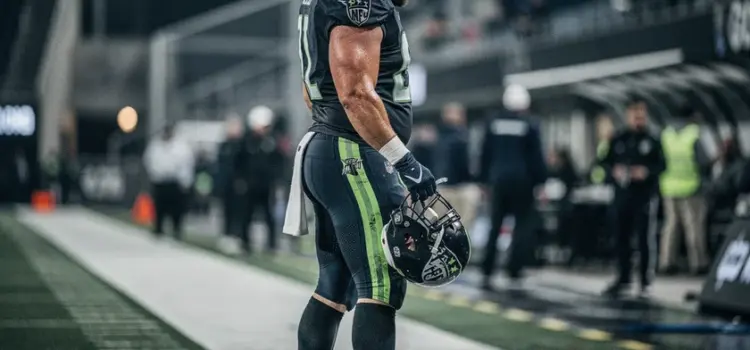
George Kittle and the San Francisco 49ers enter the 2026 offseason confronting one of the most compressed salary cap situations in the NFC West, with a single contract decision threatening to dictate every other roster move the front office can make. At the center of that pressure is left tackle Trent Williams, whose cap figure for 2026 sits at a staggering $39 million — a number the organization is actively working to restructure before the new league year opens.
The Williams situation is not happening in a vacuum. San Francisco’s roster carries well-documented needs at wide receiver and along the defensive line, and every dollar consumed by an unreduced Williams figure is a dollar unavailable to address those gaps. ESPN’s Nick Wagoner predicts the 49ers and Williams will reach a reworked agreement rather than pursue a trade or outright release, leaving the future Hall of Fame tackle in San Francisco through his age-38 season. The numbers suggest that outcome is the most cap-efficient path available, but the negotiation itself carries real leverage risk for both sides.
Why the Trent Williams Decision Affects George Kittle’s Supporting Cast
The Williams cap figure directly constrains San Francisco’s ability to upgrade the skill positions around tight end George Kittle, the offensive centerpiece Kyle Shanahan’s scheme depends on for play-action manipulation and red zone efficiency. Reducing Williams’ $39 million hit — even by restructuring $10-15 million into future void years — would create meaningful space to pursue a pass-catcher or edge rusher in free agency.
Breaking down the advanced metrics from the 2025 season, Kittle’s target share and yards-after-catch numbers remain elite for his position, but the 49ers’ overall offensive efficiency suffered when the wide receiver corps failed to generate separation on early downs. That schematic dependence on Kittle as a safety valve inflates his snap count and raises legitimate durability concerns heading into a contract year for multiple teammates. The front office brass understands that a healthier cap ledger — achieved through the Williams rework — is the prerequisite for surrounding Kittle with the weapons his usage rate demands.
One counterargument worth acknowledging: restructuring Williams’ deal pushes money into future seasons, potentially complicating the 49ers’ cap architecture in 2027 and 2028, years when younger players on rookie deals will be seeking extensions. General manager John Lynch and head coach Kyle Shanahan face a genuine tension between short-term roster flexibility and long-term cap health, and based on available data, the margin for error is thin either way.
The $39 Million Cap Figure: What It Means for San Francisco
Read more: Will Anderson Jr. and the Texans’
A $39 million cap hit for a single offensive lineman — even one of Williams’ generational caliber — represents roughly 15 to 16 percent of a standard NFL salary cap, a concentration that no contender can sustain without restructuring. The 49ers’ situation is further complicated by the fact that Williams is entering his age-38 season, meaning any restructure involves converting base salary into signing bonus proration across void years with no guarantee of on-field return.
San Francisco’s offensive line has been the structural foundation of Shanahan’s outside-zone running scheme for years. Williams, a perennial All-Pro, is the anchor of that system — the player whose presence allows the 49ers to run stretch concepts with the kind of consistent backside cutback lanes that make running backs look better than they are. Losing him to a trade or release would not just create a cap savings; it would force a wholesale schematic adjustment that neither Shanahan nor offensive coordinator Brian Griese would welcome heading into a season with quarterback questions already swirling.
The film shows that Williams’ pass-protection metrics remained among the best in the league even at 37, posting a pressure rate allowed that ranked in the top five for left tackles league-wide in 2025. That production justifies a negotiated reduction rather than a hard cut, and it gives Williams genuine leverage to demand a fair rework rather than a one-sided restructure. ESPN’s Wagoner, tracking this situation closely, frames the resolution as a matter of timing rather than outcome.
Key Developments in the 49ers’ Offseason Cap Strategy
- Trent Williams carries a $39 million cap figure for the 2026 NFL season, the largest single-player cap hit on San Francisco’s current roster.
- ESPN’s Nick Wagoner specifically predicts a reworked contract rather than a trade or release, framing the resolution as an offseason certainty.
- The 49ers have identified wide receiver and defensive line as their two most urgent positional needs entering the 2026 free agency period.
- Williams would remain in San Francisco through his age-38 season under the predicted restructured agreement, an unusual commitment for a player at that stage of his career.
- The cap pressure created by the Williams figure is described as part of a tricky contract situation that constrains the team’s ability to make additional roster moves this offseason.
What Does the Cap Crunch Mean for George Kittle’s Role in 2026?
Read more: Chicago Bears Expected to Let Jaquan
George Kittle’s role in 2026 will be shaped in large part by how much cap flexibility the 49ers recover from the Williams restructure. A leaner cap ledger opens the door to adding a legitimate X receiver opposite Kittle — a move that would reduce the defensive attention Kittle draws in 12-personnel and 21-personnel groupings and, by extension, increase his efficiency in the red zone and on play-action routes. Without that addition, Kittle remains the primary read on a disproportionate share of San Francisco‘s passing plays.
San Francisco’s front office enters the new league year with a clear priority stack: resolve the Williams situation first, then address the receiver and defensive line needs with whatever space is freed. Kittle, signed through the foreseeable future, is the one immovable asset in that equation — the player every other decision is ultimately made to protect and empower. The 49ers’ salary cap implications this offseason will reverberate through their draft strategy analysis and their approach to veteran free agents well into the summer.
Tracking this trend over three seasons, San Francisco has repeatedly used contract restructures to manufacture cap space in-season and in the offseason, a pattern that has allowed the organization to remain competitive despite carrying large veteran contracts. The Williams rework, if completed as Wagoner predicts, would follow that same playbook — aggressive short-term optimization at the cost of future flexibility. Whether that trade-off still makes sense for a roster that has not reached a Super Bowl since the 2023 season is the sharpest question facing Lynch and Shanahan this spring.
